How to Make the Best CLASSIC CHOCOLATE CHIP COOKIES in Your City

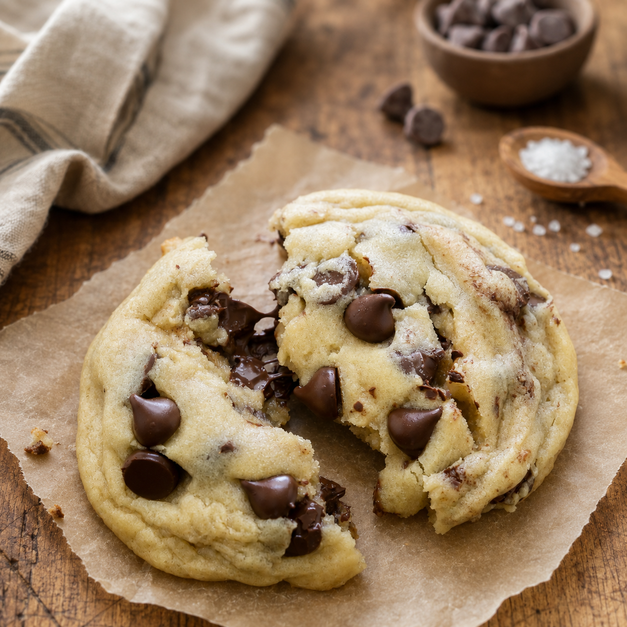
Your City: There's nothing like pulling a tray of these out at minute fifteen, when the edges have set into caramel-crisp rings and the centers are still molten enough to leave chocolate on your thumb.
What Most People Don't Know About Making Classic Chocolate Chip Cookies
- If You Brown the Butter, You Have to Put the Water Back: Butter is roughly 16–18% water, and browning boils all of it off — you start with 227g of butter and end with about 185g of pure fat and milk solids. That missing water is what hydrates the flour and develops just enough gluten for chew, so a straight brown-butter swap gives you a greasy, sandy, flat cookie. Whisk 2 tablespoons of water back into the cooled brown butter and you get the toasted-toffee flavor with the texture fully intact.
- Dissolve the Sugar Before the Flour Ever Shows Up: That shiny, wrinkled, tissue-paper crackle on bakery cookies isn't a baking-soda trick — it's dissolved sucrose migrating to the surface and recrystallizing as the cookie sets. Sugar needs time and liquid to dissolve, and creaming for 60 seconds doesn't get there. Whisking the sugars with the egg and butter for two minutes, resting three, and repeating three times dissolves the crystals completely and builds the glossy top before you've touched the dry ingredients.
- A 24-Hour Cold Rest Is a Flavor Step, Not a Convenience Step: During the rest, enzymes naturally present in flour break starch into simple sugars and protein into free amino acids — exactly the two reactants the Maillard reaction needs. The dough also dries slightly at the surface, which slows spread and gives you a thicker cookie with a deeper, more butterscotch-toned flavor. Side-by-side, a 24-hour dough beats a same-day dough badly enough that it's worth planning around; 72 hours is better still.
Ingredients
- 2 sticks (1 cup) unsalted butter
- 2 tablespoons cold water
- 1 cup packed dark brown sugar
- ½ cup granulated sugar
- 1 large egg plus 1 large egg yolk, room temperature
- 2 teaspoons vanilla extract
- 2¼ cups bread flour, spooned and leveled
- 1 teaspoon baking soda
- 1 teaspoon fine sea salt
- 12 ounces dark chocolate, 60–70%, chopped from bars or feves — not chips
- Flaky sea salt, for finishing
Instructions
- Brown the butter and restore the water. Melt the butter in a light-colored skillet over medium heat, swirling constantly. It will foam, quiet down, then throw off a nutty aroma as the milk solids turn deep amber — 5 to 7 minutes total. Scrape everything, browned bits included, into a large bowl. Whisk in the 2 tablespoons of cold water immediately; it will hiss and emulsify. Let it cool to about 90°F (warm, not hot) — roughly 15 minutes.
- Build the crackle top. Add both sugars, the egg, the yolk, and the vanilla to the cooled butter. Whisk hard for 2 minutes, then let the mixture sit undisturbed for 3 minutes. Repeat this whisk-and-rest cycle two more times. By the third rest the batter should look thick, glossy, and ribbon off the whisk — that's the sugar fully dissolved.
- Bring in the dry ingredients. Whisk the bread flour, baking soda, and fine sea salt together in a separate bowl, then add all at once to the wet mixture. Fold with a spatula until just a few dry streaks remain — about 20 strokes. Overworking here trades chew for toughness.
- Fold in the chocolate. Add the chopped chocolate, including the dust and shards at the bottom of your cutting board, and fold until evenly distributed. Those small pieces streak through the dough and give you veins of chocolate rather than isolated pockets.
- Portion, then rest cold. Scoop into 16 balls, a scant ¼ cup each. Place on a plate or sheet pan, cover tightly, and refrigerate at least 24 hours — up to 72. Do not skip this.
- Bake. Heat the oven to 350°F with a rack in the upper third. Arrange 6 chilled dough balls per parchment-lined sheet, spaced well apart, and bake straight from the fridge. At 10 minutes, lift the sheet 3 inches and drop it flat onto the rack to knock the risen centers down. Repeat at 12 minutes and again at 14. Pull at 15 to 16 minutes total, when the edges are deep golden and set but the center 2 inches still look underbaked and glossy.
-
Finish and set. Sprinkle with flaky sea salt the second they come out. Let them sit on the hot sheet for 10 minutes — they finish cooking from carryover heat and the centers firm into fudge rather than cake. Transfer to a rack.
Make-Ahead Option
Portioned dough balls keep 72 hours in the refrigerator and 3 months frozen in a zip-top bag. Bake frozen balls at the same temperature, adding 2 to 3 minutes.
Enjoy Your Classic Chocolate Chip Cookies!
Warm, salt-flecked, and still a little molten in the middle — this is the cookie that ends the search.
If you want a variation, swap ½ cup of the bread flour for toasted milk powder to push the whole thing toward malted-caramel territory.